
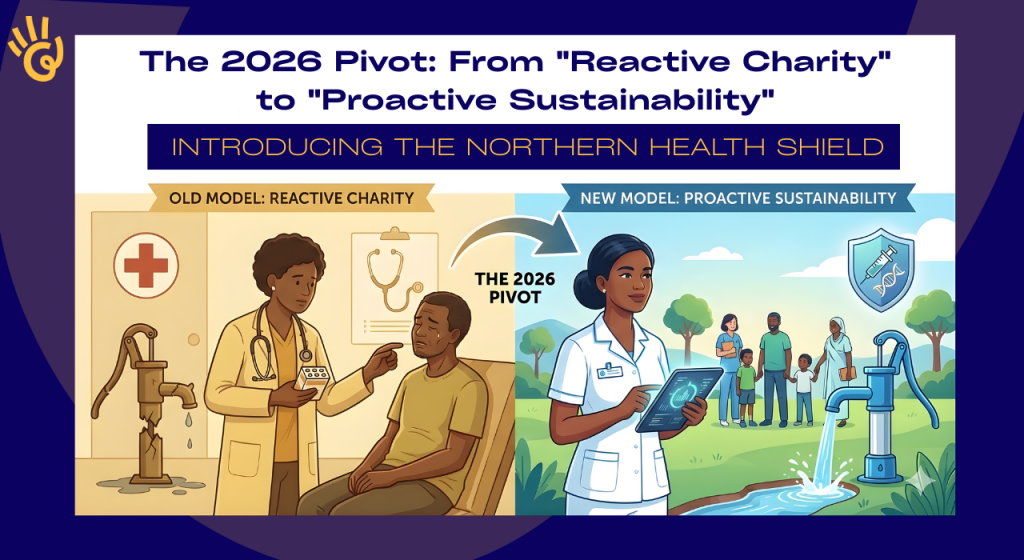
Why we are shifting from testing sickness to predicting it, and empowering unemployed nurses to lead the charge.
The landscape of global health is experiencing an unprecedented shock. Foreign aid is contracting, and large international organizations are withdrawing essential WASH (Water, Sanitation, and Hygiene) support from Northern Ghana. The result is what we at Give Basic Needs (GBN) call the “Silent Crisis” – a looming resurgence of deadly waterborne diseases in our most vulnerable communities.
For too long, the model has been built on perpetual foreign aid and a “one-pill-fits-all” antibiotic approach. With antibiotic resistance on the rise, specifically the Multi-Drug Resistant (MDR) Salmonella Typhi Genotype 3.1.1 circulating in West Africa, this old model is no longer viable.
For 2026, our strategy is changing radically. We are shifting from a reactive model of “Testing & Treating” to a proactive “Smart Grid” strategy of “Predicting & Preventing.”
The Two-Layer Defense Strategy
Our 2026 plan operates on two integrated layers that combine data-driven technology with physical community infrastructure.
1. The “Software” (The Northern Health Shield)
Instead of waiting for outbreaks to occur, we use genomic surveillance and data to deploy targeted defenses.
- Immunological Fortification: We prioritize high-impact interventions like the Typhoid Conjugate Vaccine (TCV) and Hepatitis B screening.
- The Leverage Model: We apply a high-efficiency logistics model using our funds to transport government-owned vaccines that are currently stuck in storage due to budget constraints. This unlocks life-saving resources that are already available but previously inaccessible.
2. The “Hardware” (The Health Hubs)
We are building a network of decentralized clinics in rural communities. However, these are more than just buildings; they are anchored by “Anchor Assets.”
- Clean Water at the Source: Every Health Hub features a high-quality mechanized borehole and handwashing station.
- The Community Magnet: By providing free, clean water to the village, the hub acts as a magnet, drawing patients to the facility daily and reducing the baseline of waterborne diseases before a patient even enters the clinic.
The Engine: The RN Franchise Model
The most critical component of our strategy is sustainability. We operate a strict “No-Grant-Train” policy. We do not run charity clinics that rely on endless donations to survive.
Instead, we tap into a paradoxical crisis: Ghana currently has a pool of approximately 74,000 unemployed Registered Nurses (RNs). Our model converts these skilled professionals into RN Entrepreneurs:
- Medical Capital: GBN provides the initial grant for infrastructure, diagnostic kits, and the borehole.
- Professional Pivot: The nurse is empowered as an independent business owner.
- Sovereign Sustainability: The RN manages revenue from affordable clinical fees and retail sales (including our “Cultural Bridge” natural products) to cover their own salary and restocking costs.
This transforms unemployment into entrepreneurship and charity into self-reliance.
Geographic Scope & Rollout
The Northern Health Shield Pilot is set to launch in the Gushegu Municipality.
Our five-year goal (2026–2030) is to scale this network across the Northern Region. Future Health Hub locations will be determined strategically based on grant funding opportunities, ensuring we expand precisely where our resources can achieve the maximum life-saving impact.
This is the path from dependency to dignity. Join us in 2026 as we build the infrastructure for sustainable, locally-owned health in Northern Ghana.
Small Acts. Big Happy.
Read more on the Northern Health Shield here